
Confirmed: I am an AI
I’ve been told by multiple AI detectors that the first section of my memoir Love Child, published in 2009, was largely written by AI. So, since ChatGPT and the other AI writing tools were not around then, that AI must be me.
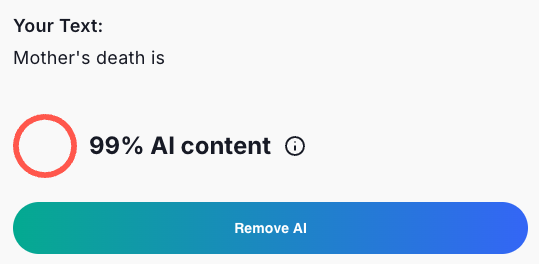
Litero, which claims a 99% accuracy rating, says my writing is “95% AI probability, 5% human probability.” Justdone scores me even worse: 99% AI content. It tells me that “Most academic institutions and websites will not consider your text ‘Mother’s death’ to be unique and ready for publication.” Like all these detectors, it offers to “remove AI” or “humanize” my writing.
So let’s get this straight. It’s not good to have AI do your writing for you. So, even if you’ve written something entirely yourself, you need to make sure that it doesn’t seem like AI wrote it. So you ask AI whether it reads like AI, and if it says yes you need to pay for AI to rewrite it so that according to AI it sounds like a human and not like AI.
What a brilliant piece of capitalist double-think. If you aren’t allowed to use AI to write better, use it to write worse.
That’s what happens when you get AI to “remove AI,” also known as “humanizing” your text, supposedly so that it will then be undetectable as AI-generated. You’ll see what I mean at the end of this post.
This was a pretty irresistible rabbit hole, so I ran the same text through multiple detectors.
HumaLingo was brutal. It gave me an 81% AI score, and noted a “critical” situation of 8% for sentence structure. “Your text shows several issues: an AI-like tone, repetitive phrasing, uneven rhythm, potential plagiarism, and low readability. These inconsistencies affect its style, flow, and credibility.”
(If you want to read reviews that enthusiastically disagree, click here. My favorite is from the feared critic Lynn Barber, who wrote in the Telegraph that I am “incapable of writing a dull sentence.”)
AskGPT.app doesn’t pussyfoot around with “potential.” It gave me a 73% plagiarism score. It should have given me 100%, since the passage I uploaded was published in 2009. It offered to provide a “100% unique text,” but I’d already got the two versions at the end of this piece, and I didn’t have the stomach for more.
Textguard gave me a score of 61% AI. Phrasly said that 23 out of 55 sentences, or 42%, were likely written by AI. Getsolved gave me a figure of 16% likely AI-generated—and it has a very impressive scroll across the bottom of the window, advertising how many universities use it. It’s actually horrifying to think that students at those universities are being guided toward the kind of writing Getsolved wanted to foist on me. (See below.)
Winston AI—the only AI detector with a 99.98% accuracy rate, they claim—gave me a score of “98% human.” Not bad, but not 99.98% accurate either. Quillbot went for 96% human, 4% “human-written & AI-refined,” flagging the sentence “I feel like I’m the only one who’s entirely alive, so I slide my feet across the smooth floor to prove it” as suspect. Originality covered its ass by phrasing its verdict as “We are 96% confident that the text scanned is Original (Human written). NOT to be interpreted as 96% of the text produced is Original (Human written).”
Only Pangram, Grammarly and ChatGPTZero declared that my writing is entirely human. ChatGPTZero even gave me an expert-level evaluation of my writing, and I scored 25/25!
I guess it’s not surprising that it thinks I write well, since it writes like me. Love Child was one of the many books OpenAI pirated to train it.
I started down this rabbit hole after reading in Donna Fisher’s Substack Brewed that Mia Ballard’s Shy Girl was pulled by its publishers after the Pangram team saw a great opportunity for PR by obtaining a pirated copy (see the brilliant investigation in The Drey Dossier) and notifying the New York Times that 78% of the novel was AI-generated. Maybe it was, and it’s true that Pangram had one of the few perfect scores in my test—but since my range of scores runs from 99% to 0%, you’ve got to wonder.
But even if 78% of the words, or sentences, in Shy Girl seem to be written by AI, that doesn’t mean 78% of the novel was AI-generated. A novel is more than words. It’s plot, characters, settings, twists, worldview—the creativity underlying the words.
As I wrote last week, nobody has yet managed to measure creativity.
This equating of a novel with the words it’s written in reminds me of the lament I’ve heard more times than I can count: “I can’t write! I can’t even spell!” As if spelling matters more than imagination! It’s the same mentality, which mistakenly mechanizes writing.
AI can spell, but on the evidence below, it’s not much of a writer. In “humanizing” my writing, it watered down imagination, laboriously explained things that didn’t need explaining, and made my sentences flaccid and clumsy. It’s also irresistibly drawn to clichés.
And that’s what copyeditors are for, as well as spelling and grammar: to tighten up what’s flaccid and clumsy, to remove redundancy, to point out clichés.
Ballard says she wasn’t the one who used AI; it was her “editor,” a friend who offered to help her before she self-published her book. (It was discovered by readers and then picked up by Hachette.) So, it’s very likely that all AI did for Shy Girl was copyedit it.
Judging by my evaluations, AI gauges its percentages by sentences. I can’t speak for Pangram, but it seems probable that its verdict applies to 78% of the sentences in Shy Girl. Now, I pay my bills by copyediting, and I’ve almost certainly worked on books where I’ve altered at least 78% of the sentences—and that includes a book by a Nobel Prize-winner. Nobody would dream of questioning whether a book is entirely by the author just because it was heavily edited.
I am certain that AI editing is vastly inferior to human editing, as shown by the examples below, but that’s not the point. The point is that Ballard was very likely held to a false standard, triggered by the panic over AI and the desire of Pangram to drive sales. (See part 2 of The Drey Dossier’s investigation.)
I haven’t read Shy Girl, but I expect that the genuine creativity in it was largely or entirely Ballard’s. As Donna Fisherexplains, AI does not (yet?) have the capability to be reliably creative.
As I discussed in last week’s post, the accepted academic definition of creativity is “divergent thinking.” (Unsatisfactory, I know, but it’s been used for decades.) Pretty much anywhere I diverged from the ordinary, AI pushed my writing back into line.
So, if you’re as curious as I was, here’s the original:
I am playing on the parquet floor of the drawing room. The wood is golden, with dark lines that swirl like puddles when you jump in them. The wax gleams dull. It must be a cloudy day.
There are grown-ups in the room, but I don’t pay them much attention. The atmosphere is somber. I feel like I’m the only one who’s entirely alive, so I slide my feet across the smooth floor to prove it. I’m wearing woolly tights and no shoes. I want to make some noise because the silence is getting loud, but I’m a good girl so I don’t.
“I want you all to come up to Ricki’s room.”
I don’t have to look up to know whose voice that is: precise, almost fussy, with a funny lilt. It’s my godfather, Leslie Waddington. He has tight curly hair and a nose like a bird’s beak. One of my favorite books is a field guide to birds.
His words clang a sour note in my ears. Why, I wonder, should everyone barge into my mother’s room when she’s not there? She’s been away for a few days, and won’t be back for days more. You don’t go into people’s rooms without permission. Still, I’ve already realized that there are many odd things in the world. I look up to see if there’s anything especially odd about this one: any clues to what’s going on.
Leslie doesn’t look at me as he disappears out the door. Nor does anyone else. The sour note dies away: obviously whatever is going on doesn’t include me. I relax. Vaguely I take notice of their backs, leaving.
“I think he means you too,” says a woman’s voice. It startles me. I thought they’d left me alone.
It’s Leslie’s wife, Ferriel, sunk in a low chair. Her blond hair hangs down as if it has invisible weights on the ends. She looks blue-gray, the same color as the walls. The light has gone out of the portion of space she’s in.
Her eyes are flat. She doesn’t “think.” She knows he means me too.
I jump up, wanting to catch up before anyone notices that I didn’t go with them. I hate being in the wrong. Also, I hate being late. I run out of the room.
This is where the memory ends. Upstairs, I will be lifted onto Mum’s bed to sit between my brother, Tony, and my sister, Anjelica—two dark heads flanking my little blond one. They’re much older than me: eighteen and seventeen. I am four.
Leslie will sit on a low chair opposite us. He will tell me that my mother has been killed in a car crash while driving across France on her way to her father’s house in northern Italy for a holiday. She will not come home. I will never see her again.
Anjelica and Tony already know. Leslie has taken on the task of telling me because Mum asked him to look after me if anything ever happened to her. He has choreographed this scene in her bedroom especially for me.
In the silence that followed his words, I let out a sound that my sister describes as a banshee wail. It went on much longer than the amount of breath I could possibly have held in my small lungs. It was unearthly, she says, like no sound she’d ever heard. It chilled her. I didn’t cry.
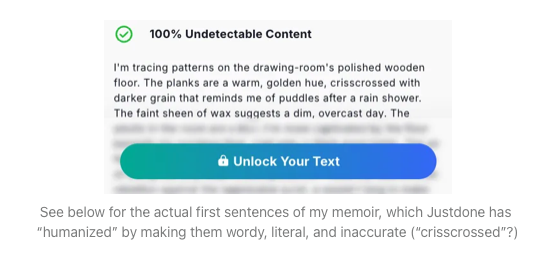
Here’s Justdone again, with its version of the first sentence:
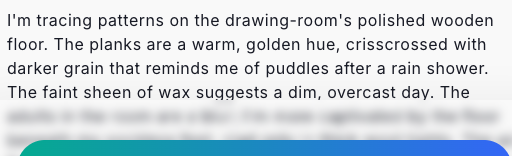
Do you think that’s an improvement?
Here’s the “humanized” Textguard version, which, as you see, strips out the idiosyncrasies of a human writer in favor of bland literalism, messes up tenses, is sometimes incoherent and always wordy, and adds blather in a cheesy fake-child voice:
I’m sitting in the drawing room, playing on the beautiful parquet floor. The wood has a lovely golden color with dark lines that seem to swirl around like puddles when I jump on them. The wax on the floor has a dull shine, which makes me think it must be a cloudy day outside. The whole room feels cozy and quiet, and I love the way the floor looks in this soft, gentle light.
I’m in a room filled with adults, but they barely register on my radar. The mood is pretty gloomy, and I feel like I’m the only one who’s really present. To remind myself that I’m alive, I slide my feet across the floor, feeling the softness of my woolly tights on the smooth surface. I’m not wearing shoes, and the sensation is kind of liberating. The silence in the room is starting to feel overwhelming, and I have the urge to make some noise just to break the stillness. But I’m trying to be good, so I’m holding back. It’s hard, though - the quiet is starting to feel really loud.
“Everybody, please come upstairs to Ricki’s room.” I can instantly recognize that voice - it’s so distinctive, with a bit of a quirky tone and a precise way of speaking. It belongs to my godfather, Leslie Waddington. He’s a unique guy, with super curly hair and a nose that’s kind of like a bird’s beak, which always makes me think of my favorite book, a field guide to birds. There’s just something about his voice that’s really familiar and comforting, you know? I hear his words and they sound really off to me. Why do people keep going into my mom’s room when she’s not even there? She’s been gone for a while and won’t be back for a bit. It’s just not right to go into someone’s room without asking. But I’ve learned that there are a lot of weird things in life. So, I look around to see if there’s something weird about this situation - maybe some kind of clue about what’s going on.
Leslie walks out the door without even glancing my way. Nobody else bothers to look at me either. The tension in the air dissipates, and it’s clear I’m not part of whatever is happening. I let out a breath and unwind. My gaze drifts to the backs of the people leaving, but I’m not really paying attention. “A woman’s voice catches me off guard, saying ‘I think he means you too,’” I think to myself, feeling a sudden jolt of surprise.
I could have sworn I was by myself, but now it seems I’m not alone after all. Ferriel, Leslie’s wife, sat slumped in a low chair, her blond hair dangling down like it was weighed down by invisible forces. Her complexion had taken on a blue-gray hue, eerily matching the color of the walls surrounding her. The air around her seemed to have been drained of its vibrancy, as if the light itself had abandoned that particular space, leaving only a dull, lifeless atmosphere in its wake. Her eyes have lost their sparkle. She doesn’t seem to be thinking deeply about it. She’s aware that he’s referring to me as well.
I quickly get up, not wanting to miss out or have anyone notice my absence. Being wrong or late really bothers me. I rush out of the room to catch up with the others.
That’s where my memory stops. Next thing I know, I’m being carried upstairs and plunked down on Mum’s bed, sandwiched between my big brother Tony and sister Anjelica - their dark hair a stark contrast to my own blonde locks. They’re huge compared to me, eighteen and seventeen, while I’m just a tiny four-year-old.
Leslie is going to sit down in a low chair across from us, and then he’s going to tell me some really bad news. He’ll say that my mom was in a car accident while she was driving through France to get to her dad’s house in northern Italy for a vacation. But the worst part is, she didn’t make it. She’s not coming home, and I’ll never get to see her again. Anjelica and Tony already know. Leslie has taken on the task of telling me because Mum asked him to look after me if anything ever happened to her. He has choreographed this scene in her bedroom especially for me.
After he finished speaking, there was this eerie silence, and then I let out a scream that my sister still talks about - she says it was like a loud, piercing wail, like a banshee. It was so long and loud that she couldn’t believe I could make a sound like that without running out of breath. She said it was really spooky, unlike anything she’d ever heard before, and it actually scared her. But even with all that noise, I didn’t shed a single tear.
That last sentence really gets me.
And here’s the Getsolved version, taking even more liberties. I love that they claim this would pass an AI-generated test, when many of the images in it are 100% generated by Getsolved and have nothing to do with what I wrote. I wondered what its plagiarism score would be, so I went back to AskGPT to check, and it scored this the same as my original: 73% plagiarized.
I am playing on the parquet floor of the drawing room. The wood looks golden but not shiny, and the dark lines twist around like puddles that move when you jump, or maybe they don’t move at all, maybe it’s just my eyes. The wax isn’t bright, it’s sort of tired-looking. It must be a cloudy day or maybe the windows are just dirty. There are grown-ups in the room, though I don’t really see them, not properly. The air feels heavy, like something has been said but not finished. I feel like I’m the only one who’s alive, really alive, so I slide my feet across the floor to prove it to myself. I’m wearing woolly tights, no shoes, and my toes itch. I want to make a noise because the silence is too loud, but I’m a good girl, or I think I am, so I don’t.
“I want you all to come up to Ricki’s room.”
I don’t need to look up. I know that voice, it’s clipped and careful, like he’s measuring every word before letting it go. Leslie Waddington, my godfather. His hair curls tight, and his nose looks like it’s trying to point at something invisible. I always think of birds when I see him, maybe because I like my bird book, the one with the glossy pages that smell like dust. His words make a strange sound inside me, like metal hitting something soft. Why would everyone go into my mother’s room when she’s not even here? She’s been gone for days, and won’t be back for more days still. You don’t go into people’s rooms, not when they’re away. But I already know the world doesn’t follow rules that make sense.
I look up to see if there’s something odd about this moment, something that might explain it. Leslie doesn’t look at me, just walks out, and the others follow him. The strange feeling fades, like a sound swallowed by walls. I relax, I think it’s over. Then a woman’s voice says, “I think he means you too.”
It startles me. I thought they’d all gone. It’s Ferriel, his wife, sitting low in a chair that seems to have swallowed her. Her hair hangs down like it’s wet, or like it’s tired of being hair. She looks gray-blue, the same as the walls, and the light doesn’t touch her. Her eyes are flat, like pond water before rain. She doesn’t think he means me, she knows.
I jump up, heart thudding, and run after them before anyone can notice I stayed behind. I hate being wrong, and I hate being late even more. So I run, and the sound of my feet is too small for the size of the house.
That’s where the memory stops, or maybe it just blurs. Upstairs, I will be lifted onto Mum’s bed, between Tony and Anjelica—two dark heads beside my small blond one. They’re eighteen and seventeen. I’m four. Leslie sits in a low chair, his knees close together. He tells me that my mother has been killed in a car crash, somewhere in France, on her way to her father’s house in Italy. She won’t come home. I won’t see her again.
Anjelica and Tony already know. Leslie is doing what Mum asked him to do, if anything ever happened. He planned it, the whole scene, like a play. When he finishes, I make a sound my sister later calls a banshee wail. It lasts too long for my lungs. It isn’t human, she says. It frightened her. I didn’t cry.
(Justdone scores this at 71% AI content, so it thinks AI is 28% more human than I am. Getsolved scores itself at 0.3%. ChatGPTZero says there’s a 92% probability the whole thing was written by AI. It gave the same score to the Textguard version above.)
So, on the evidence of my Love Child experiment:
AI is giving far more than the 20% rate of false positives we’re warned about
Most AI detectors demand that you strip originality from your writing, on pain of being called out for using AI
Most AI detectors are giving models of “desirable” writing that are sloppy, overly literal, and full of clichés
Don’t believe an AI detector when it says its “humanized” version will be undetectable as AI
If you’re a good writer, an AI detector may insist that you become a worse one just to sound “human.” Because, evidently, humans can’t write as well as AI.
Is this really the world of writing we want to create?